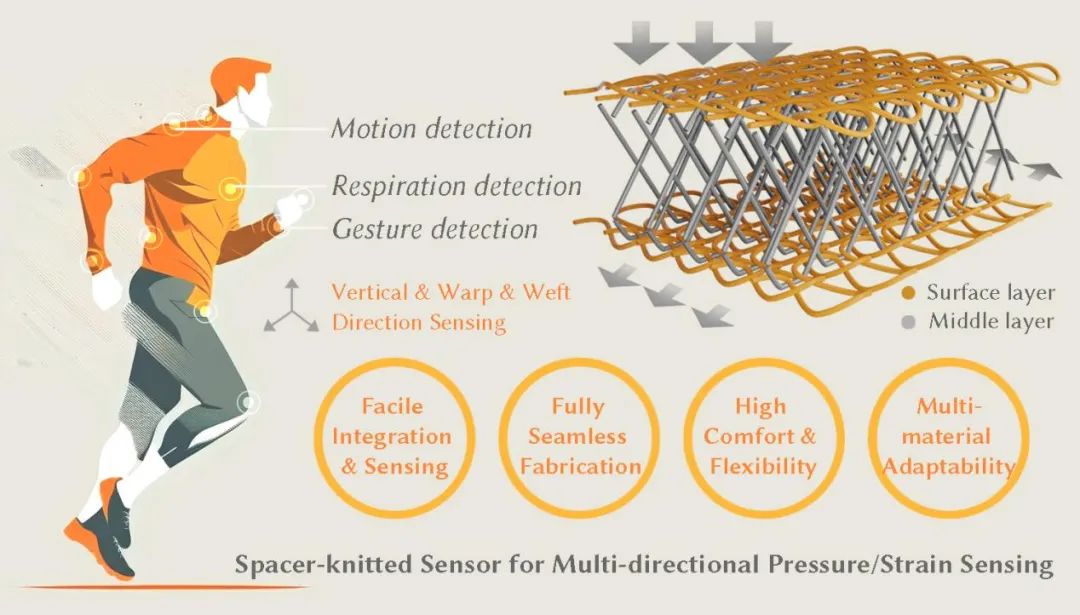
Smart textiles provide highly comfortable sensing methods and interfaces for sensing body movement parameters in daily life. Knitting, a traditional textile manufacturing method, enables a completely seamless unibody preparation in e-textiles. It is still difficult to create wearable textile sensors that meet both the strain and pressure sensing requirements for the all-around detection of motion for two reasons: (1) The flat/two-dimensional knitted sensors can only sense the deformation at the horizontal level. However, human kinematics involves dynamic detection of multidirectional motion parameters, and unilateral direction motion monitoring can barely meet the needs of complex motion monitoring tasks. Thus, improving the electromechanical performance requires more than a flat knitting structure. (2) The human body has requirements for the comfort threshold of wearable products (maximum 2000–3500 Pa ). Most existing commercial film/textile sensors cannot meet the small-scale measurement requirements of wearable products. So small measurement range textile sensors need to be developed for comfortable on-body sensing.
Recently, the team of Prof. Ziqian Bai at the Southern University of Science and Technology (SUSTech) and the Hong Kong Polytechnic University (HKPU) collaborated to develop a woven unibody spacer-structured piezoresistive knitted sensor with three-way sensing capability. This 3D knitted sensor structure is characterized by high sensitivity and multi-directional strain/pressure sensing. The innovative sensor structure and design, excellent comfort and breathability make it a highly compatible sensor for human wearable applications and suitable for large-scale computerized knitting machine production. It provides a new solution for application scenarios such as multi-motion parameter motion monitoring, body shape recognition, and gesture interaction. The study was published under the title of “Three-directional Spacer-knitted Piezoresistant Strain and Pressure Sensor for Electronic Integration and On-body Applications” in the journal ACS Applied Interface & Material with a cover story.
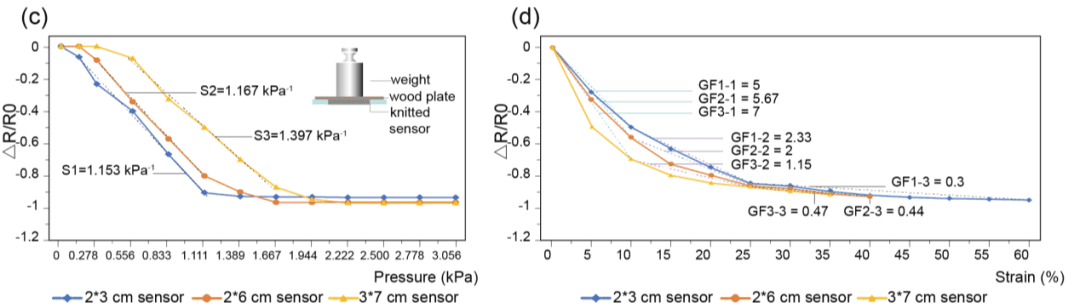
This research presents a novel fully machine-knitted spacer piezoresistive sensor structure with a three-directional sensing ability that can detect both the pressure in the vertical direction and the strain in the warp/weft direction. Besides, it can sense the pressure under 1 kPa, which is critical in comfortable on-body interaction, one-piece integration, and wearable applications. Three sizes spacer-knitted sensors are evaluated in terms of their mechanical performance, stability cycles, and reaction to external factors such as sweat, laundering, etc. Then, the effect of material choice on sensor performance is evaluated and the rationale behind the use of different materials is summarized.
Specifically, this research presents a detailed evaluation of the applications with both a single sensor and multiple sensor arrays for fine and gross motion sensing in several scenarios. The testing results demonstrate a fully machine-knitted piezoresistive sensor that can detect multidirectional motions (vertical, warp, and weft directions). In addition, this knitted sensor is scalable and can be facilely and seamlessly integrated into any garment piece. This universal knitted sensor structure could be made with a wide variety of materials for high sensitivity for multidirectional strain/pressure sensing, making it a high-compatibility sensor structure for wearable applications.
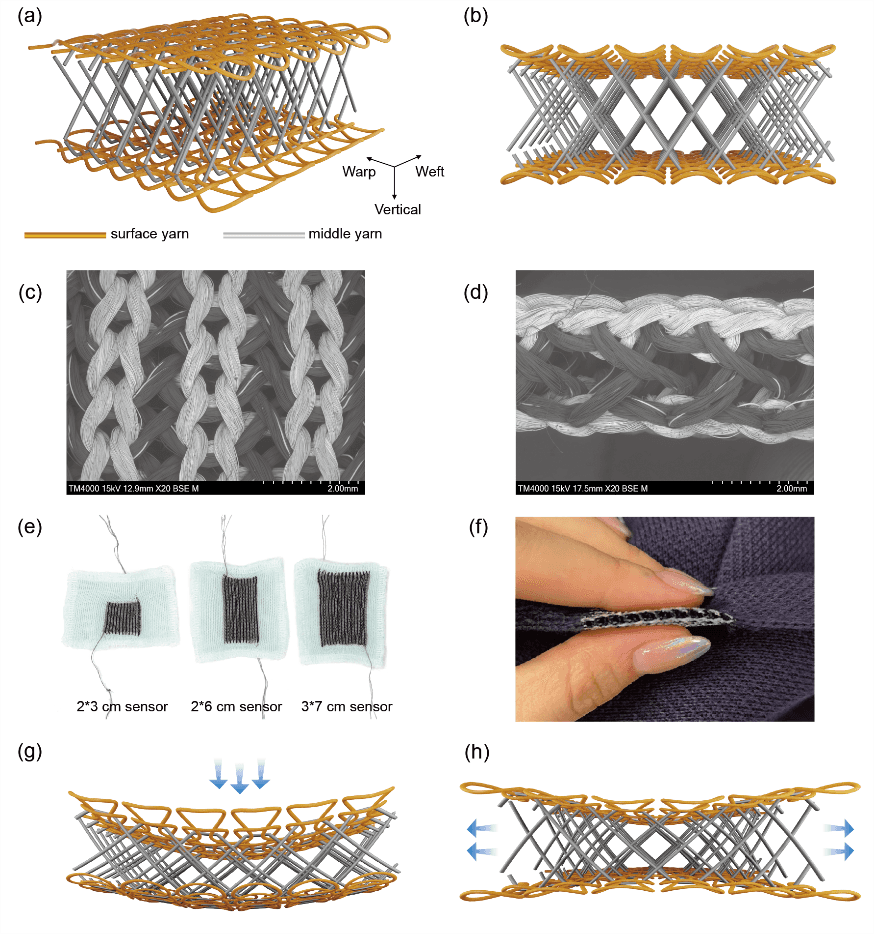
Fig. 1 (a) Schematic diagram of the three-directional structure of spacer-knitted sensor; (b) section view of the sensor model; (c) SEM images of the surface and (d) section views of the spacer-knitted sensor; (e) surface and (f) section views of spacer-knitted sensor samples of different sizes; (g) model of knitted sensor compressed in the vertical direction; and (h) model of knitted sensor stretched in the weft direction.
Fig. 2 Basic sensing performance of spacer-knitted sensor: (c) sensitivity testing of the pressure sensor─all three sizes; (d) gauge factor testing of the strain of all three sensors in the warp direction.
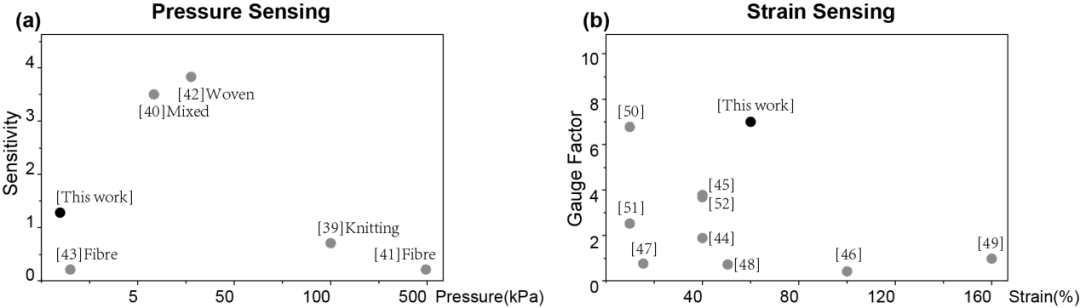
Fig. 3 (a) Sensitivity comparison among textile pressure sensors; (b) gauge factor comparison among knitted strain sensors.
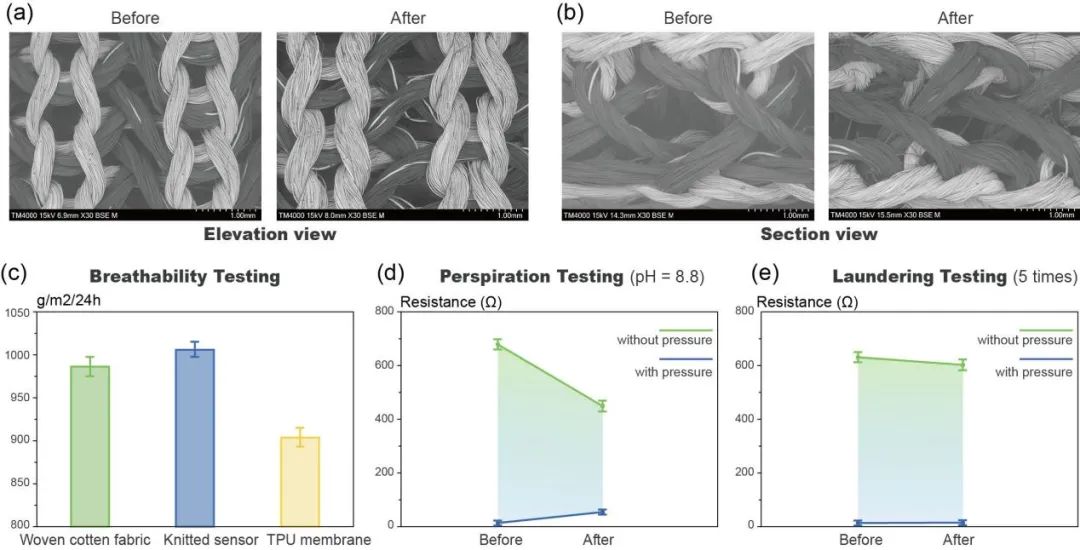
Fig. 4 (a, b) SEM images of the spacer-knitted sensor before and after stability cycle testing; (c) breathability testing result of cotton fabric, spacer-knitted sensor, and TPU membrane; (d) perspiration testing of spacer-knitted sensors; and (e) laundering testing of spacer-knitted sensors.
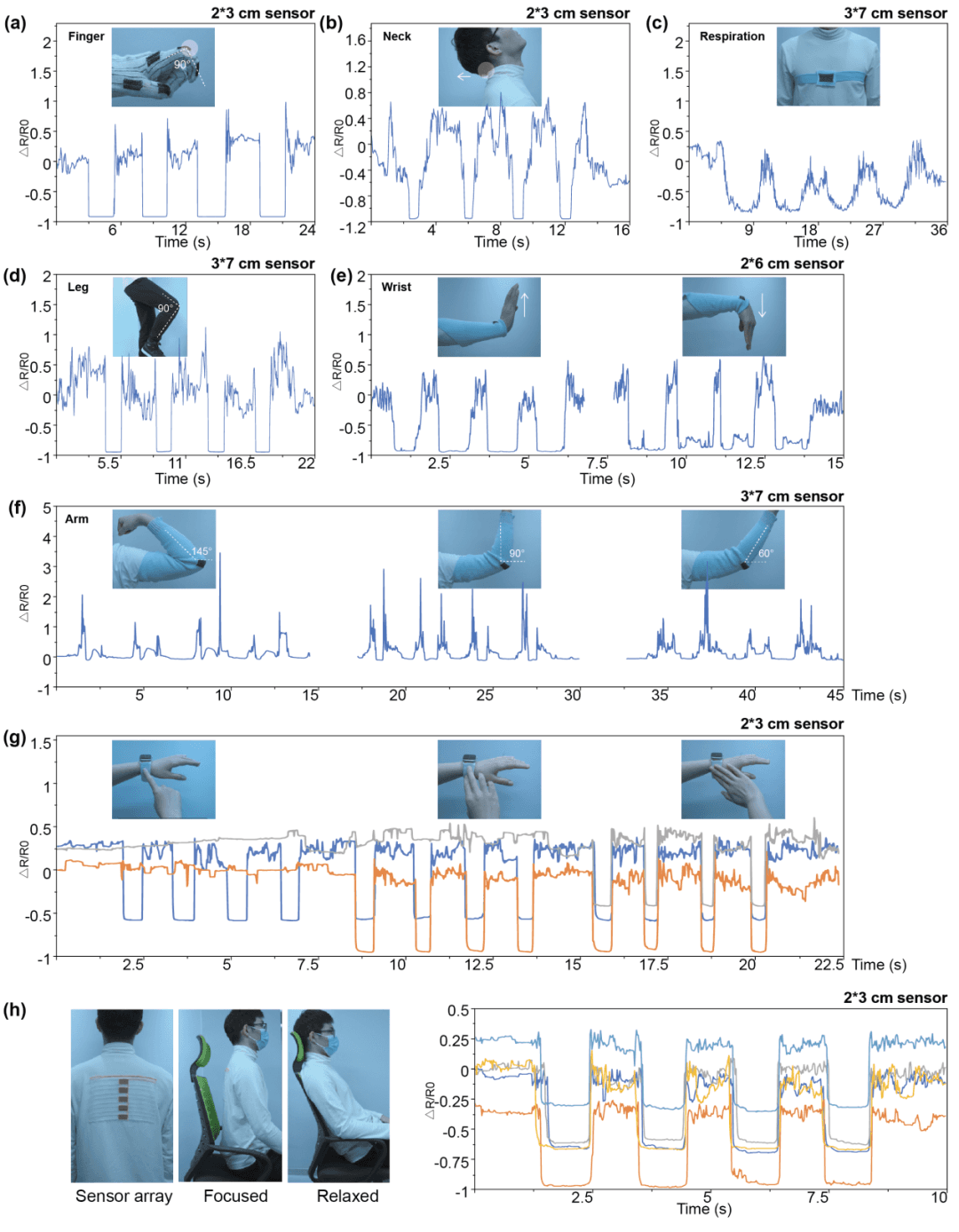
Fig. 5 Application of spacer-knitted sensors for real-time fine motion monitoring: (a) finger bending, (b) neck bending, and subtle (c) respiration after sports participation. Real-time detection of gross motions: (d) knee bending, (e) wrist bending upward and downward, (f) bending arm at angles of 60, 90, and 145°, (g) use of a sensing array to detect interaction gestures on a smartwatch strap made of multiple spacer-knitted sensors, and (h) use of on-body spacer-knitted sensor array to detect whether the driver’s body is in a relaxed or focused state.