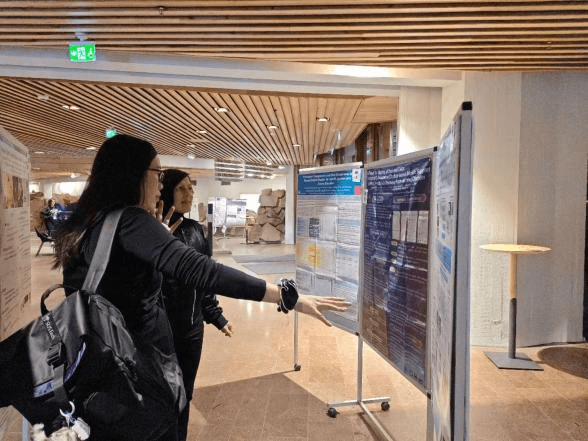
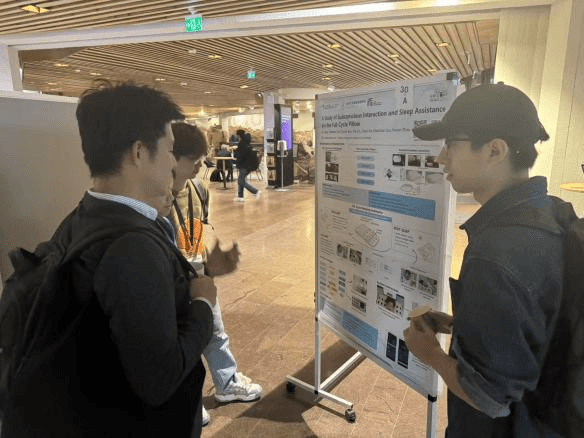
The 2025 Ubicomp/ISWC conference was held from October 12 to 16 at Aalto University in Finland. Professor Bai Ziqian’s HCID team from the School of Automation and Intelligent Manufacturing at Southern University of Science and Technology participated in the conference, presenting their research on the application of LLM in human-computer interaction. Their work attracted significant attention among more than 20 Student Challenge entries.
During the conference, the team engaged in in-depth discussions with researchers from Nanjing University, Shanghai Jiao Tong University, The Hong Kong University of Science and Technology, Columbia University, and other institutions on the topic of "LLM-Based Analysis of College Students’ Morning Smartphone Addiction Behavior." Their research was met with widespread acclaim.
Team members' communication with other research scholars
Introduction to the Research Background and Contributions of the Paper
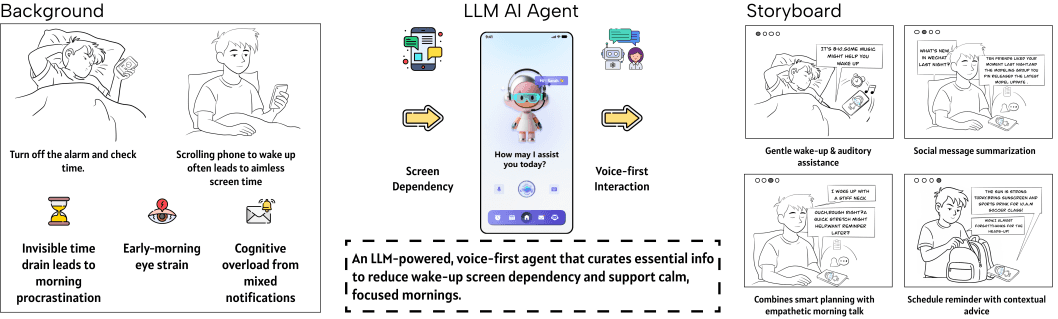
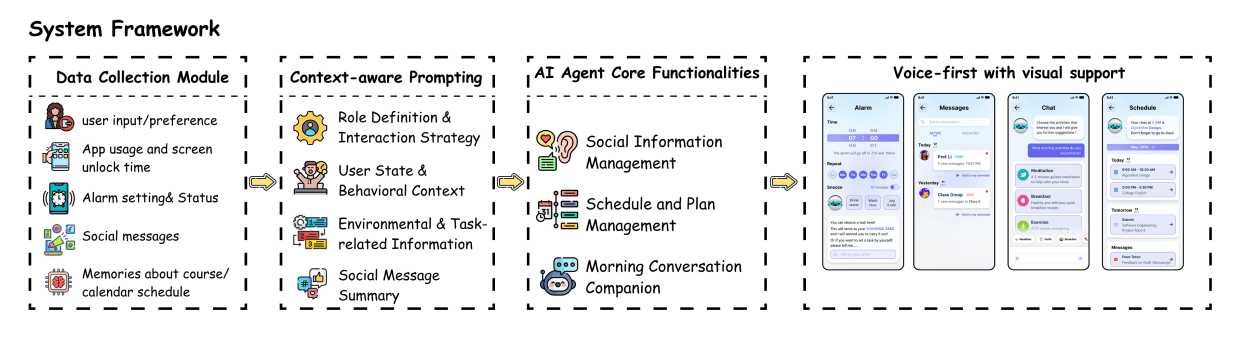
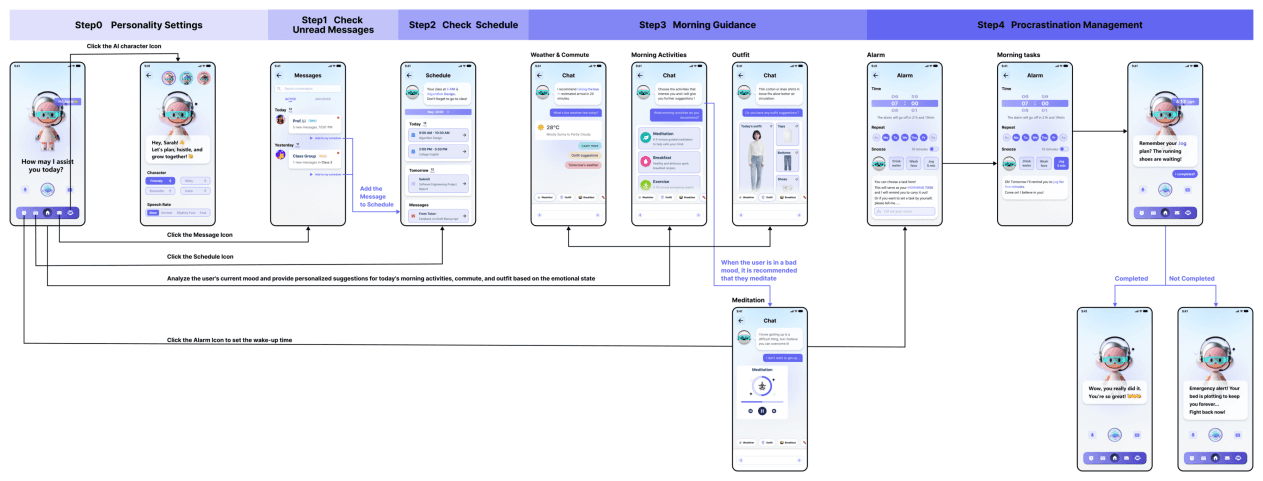
In today's fast-paced life, it has become a common yet hard-to-break habit for university students to immerse themselves in the virtual world of their phones immediately upon waking up in the morning. However, this morning reliance on smartphones not only diminishes their ability to make rational use of the early hours but may also lead to increased emotional stress, causing them to miss out on a healthy start to the day. Traditional phone usage patterns are passive and rely on users' active initiation, which limits the potential to uncover healthy behavioral patterns hidden within morning routines. To address this issue, we conducted formative research and developed an LLM-based AI assistant designed to help university students reduce their excessive dependence on smartphones upon waking. This AI assistant analyzes users' real-time emotions, behavioral patterns, and personalized profiles, leveraging a large language model to provide personalized, context-aware suggestions. It not only helps reduce users' dependency on screen time but also delivers key information through voice interaction, thereby alleviating anxiety associated with prolonged phone use. Laboratory evaluations and real-world testing have shown that this AI assistant effectively mitigates excessive morning phone dependency, reduces anxiety linked to extended screen time, rekindles attention to healthy morning habits, and enhances users' awareness of the connection between their behavior and emotions. Furthermore, we focus on transforming mundane daily moments into positive behavioral experiences. Through this approach, this paper aims to offer university students a healthier and more positive morning lifestyle, helping them start their day on a better note.
Research Methods and Findings
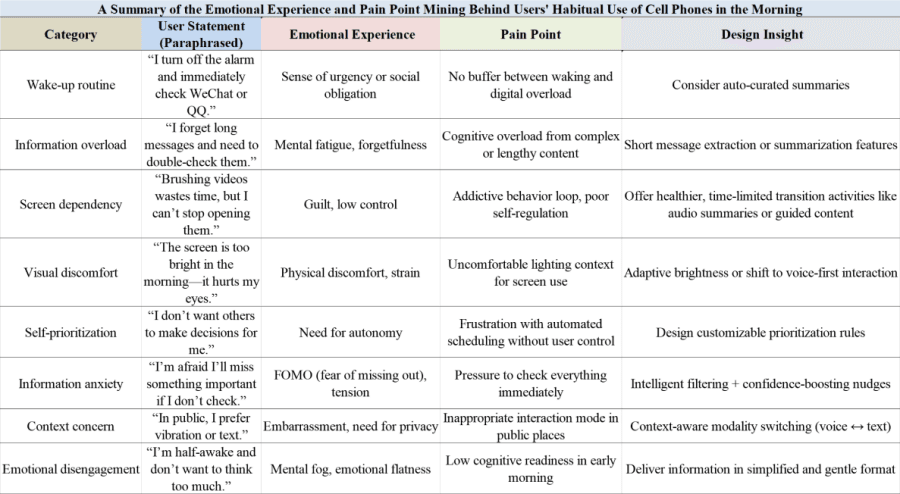
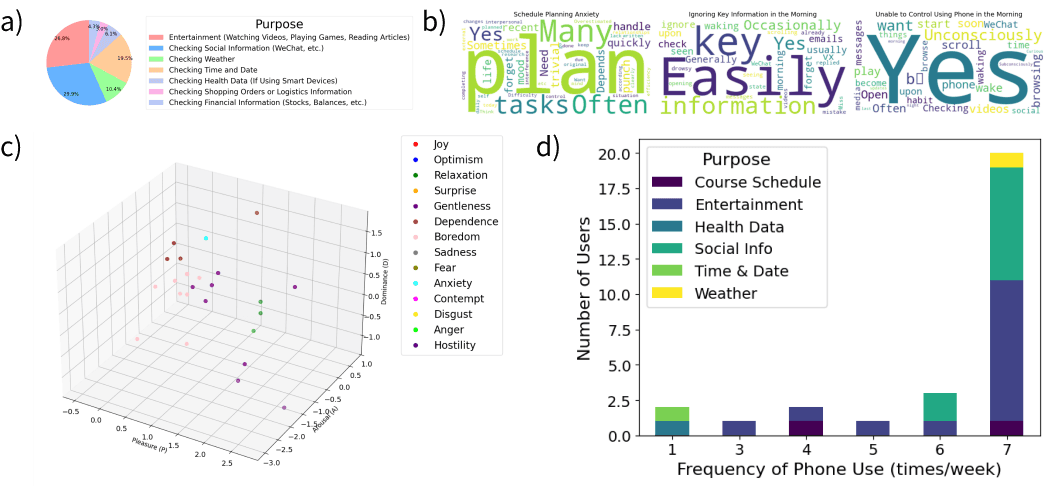
a) The primary reasons for checking the phone after waking up.b) The behavioral tendency of using a smartphone as the first action in the morning.c) The distribution of emotions in the PAD 3D space.d) The relationship between emotions and frequency of smartphone use when it is the first action in the morning.
This study employed semi-structured interviews and questionnaire surveys to conduct user research. Through these methods, it identified users' core needs for a voice-based AI assistant, including: automatically extracting messages, updating schedules and detecting conflicts, conveying information through a combination of voice and text; maintaining control over priorities and schedules; providing personalized multimodal content as an alternative to mindless phone use; automatically activating the assistant after turning off the alarm; and context-aware privacy protection. The questionnaire, which surveyed 29 university students, revealed that their primary morning phone activities involved checking social media, entertainment content, or viewing the time, date, and weather. After analyzing the data using the PAD emotion measurement method, it was found that users who used their phones upon waking up seven times per week were more prone to negative emotions such as anxiety, boredom, sadness, and dependency.
System Framework and System Prototype
Cite:Fang, Q., Tan, Q., Xia, Z., Lin, K., & Bai, Z. (2025). The LLM-based AI agent for college students to reduce smartphone addiction in the morning. In Companion of the 2025 ACM International Joint Conference on Pervasive and Ubiquitous Computing (UbiComp Companion ’25) (October 12–16, 2025, Espoo, Finland). ACM, New York, NY, USA. https://doi.org/10.1145/3714394.3750588